Reflecting on 'Colours and Forms of Australian Design' with JAU Founder Sonny Mai
Thank you to everyone who visited our pop-up at Think of Things, and to everyone who came to the talk. I gave it together with Yasunaga-san, a creative director and producer at Kokuyo, the two of us moving between Sydney and Tokyo and comparing how each city lives. I hope you got something out of it. This is the follow-up as there wasn’t much time to share more thoughts on what shapes the "colours and forms" of Australian design, and why I care so much about bringing Australia and Japan closer together.
For about five years now, the JAU team and I have been introducing Australian design and culture here in Japan. It's always an interesting challenge for us when asked about what Australian design is. So this piece covers some thoughts on it, but not a conclusive definition, as I think it's quite difficult to define.
Australia's design story begins long before the modern era. Aboriginal and Torres Strait Islander peoples have the oldest continuous living culture in the world, going back tens of thousands of years, with a deep relationship to the land and their own colours and forms: design and art that carry story, and a deep connection to nature and to their people. My focus in this piece will be the more recent chapter: the modern story of how waves of migration, and the meeting of many cultures, have shaped Australian design.
Modern Australia is young and its culture is still forming, which is part of why its design isn't easy to define. When I say "colours and forms," I don't just mean literal colour and shape. I mean the influences behind a designer's work. I will be mainly looking at the cultural and environmental influences that may influence an Australian designer's thought process and goals for their design as well as sharing some anecdotes about what it was like to grow up in Australia to provide my context.
As an aside, my own parents came to Australia as refugees from Vietnam in the 1980s, escaping the aftermath of the war. I was born and grew up in Australia. Now I've become a migrant myself: living in Japan, raising a family here and running a business. Living between two countries is a big part of why I care so much about what shapes Australian design, as I want to share more about the country that provided refuge and opportunity for my family. It also goes the other way: I've always had a deep respect for Japanese culture, design and craftsmanship. Now that Japan is my home, I'd love to find ways to share it beyond Japan too.
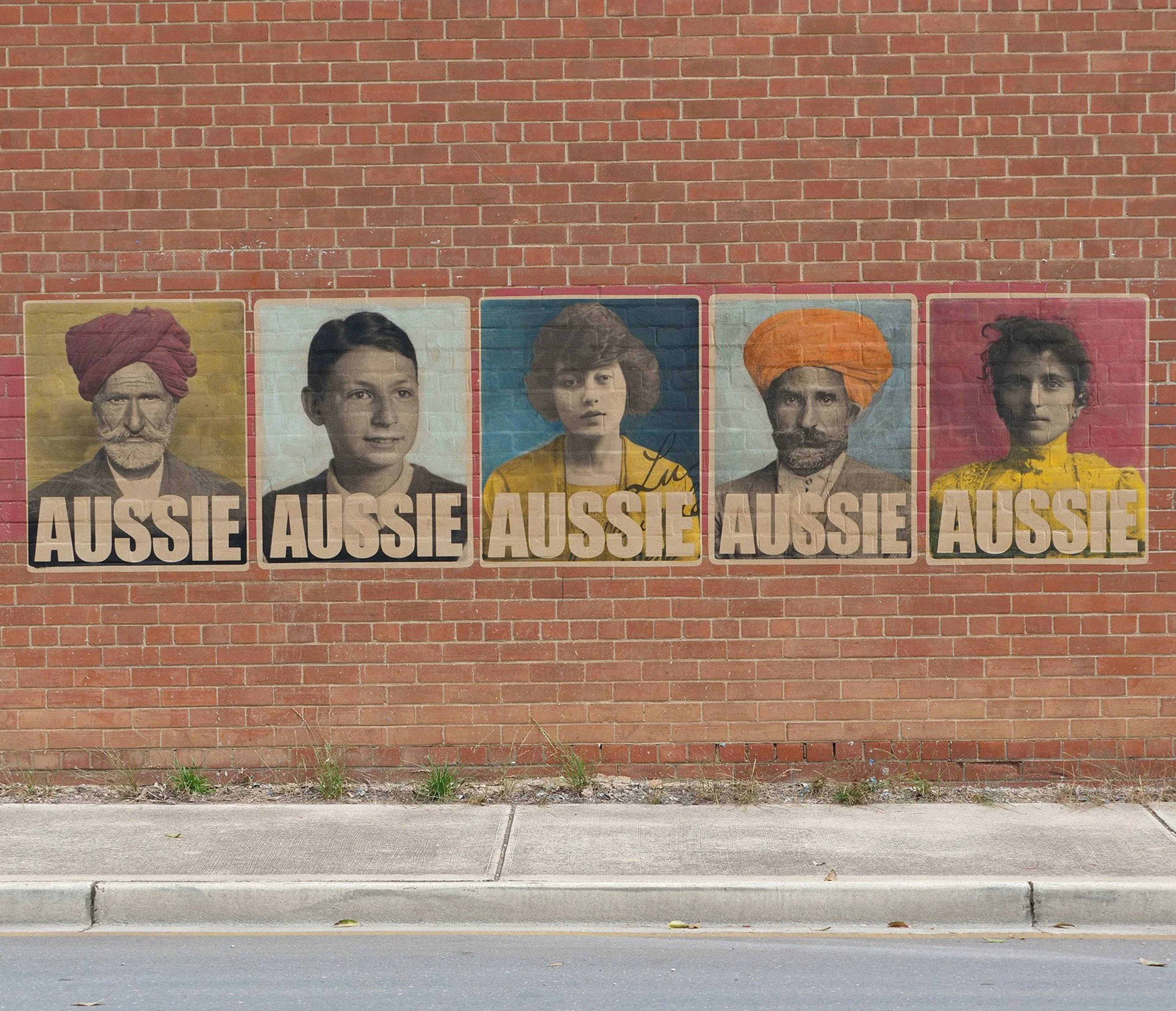
AUSSIE Posters by Peter Drew
A mix of cultures
I'll start with people, because for the past 200 years Australia has been built by immigration: people looking for new opportunities, or escaping the consequences of war.
The earliest migrants came from Britain. Then the gold rush of the 1850s raised Australia's population from around 400,000 to over 1,000,000, with many arriving from Europe and China. The 1940s brought a large wave of Eastern Europeans: Lithuanian, Estonian and Polish people escaping the aftermath of the Second World War. The 1960s and 1970s brought people from Turkey and Lebanon, many recruited for work in Australia's growing factories, with more Lebanese arriving to escape war from 1975. The late 1970s and 1980s brought a wave from Southeast Asia, especially Vietnam, where the war and the fall of Saigon forced many families to leave, including my own. The 1990s and 2000s were mostly skilled migrations from India and China.
So Australia is far from homogeneous. What is interesting to me is that so many people came to start a new life, and they came knowing how far away and isolated Australia was. Many of them were, in a way, risk-takers, whether they had a choice or not.

Sonny and friends in highschool
When I was at school, my group of friends was really mixed, with friends whose families were from Finland, the Netherlands, Greece, Macedonia, Italy, Russia, Turkey, Poland, Lebanon, Taiwan, Hong Kong, and more. We knew where each other's families came from, sometimes we'd make jokes about each other's differences, but we never really felt too different from one another. Looking back, I think that feeling, that our differences were just normal, is a big part of what makes so many Australians open and easy-going.
It also means cultures quietly mix and influence each other, as we learn about one another and the way we each live. Even far from home, each family made their home surroundings feel close to what they had left behind. When I visited my Finnish friend's house, it felt warm: wooden furniture, wooden floors, and they even had a sauna in their backyard, which is the most Finnish thing you could have. At my Greek friend's house, there were tiled floors, a concrete and brick backyard, and a pool, all reflecting a Mediterranean way of living. My Lebanese friend's house would have multiple shishas set up in the backyard, and their parents would always offer baklava (sweet pastry) and zaatar (herb flat bread). And in my own family's home, we had, and still have, the same little plastic stools you find on the roadside in Vietnam, where people sit and eat street food. We also keep incense burning to pray to our ancestors, as we would do in Vietnam.

Sonny and friends in grade 11 of highschool
At the time, I took all of this for granted. But growing up around it, you pick up something without really noticing: that there's no single "right" way to live, and that can spill over into how a designer works, too. Nothing is the default. And I think that openness, which almost everyone who grows up in Australia shares, is a big part of what shapes a designer there. You learn to borrow freely, and to mix influences, maybe intentionally or unintentionally. That openness has another side, too. Because there's no single, centuries-old tradition telling people how things should be done, there's also no fixed idea of who's allowed to be a designer.

Chub, Window chair and Block by Fearon
Fearon is an interesting example. Jack and Mark Fearon are brothers. Before they made furniture, they were tradesmen: Jack was a plumber and Mark a boilermaker, and they built big water tanks for trucks. They had no formal design training at all. Their very first piece, a stool, came from playing around with leftover metal from a tank in their workshop. Their work quickly became popular, and they are now full-time "designers". They acknowledge they have no design background, and they are happy about that, because they aren't held back by the usual traditions, or by anyone's idea of what design "should" be. They just make what feels right to them.

MAHO Sensory Gypsy Wood Incense and R.L.Foote Design Mochi Incense Holder
Joshua Tong is a different kind of example. His brand, MAHŌ Sensory, began somewhere very personal: his mother taught him that incense is the vessel that carries your prayers to the heavens, the same ritual I described in my own home. But what he does with that tradition is all about mixing. He takes traditional Asian incense and gives it a Western, almost perfumer's sensibility — soft, floral, layered scents closer to a European fragrance house than to traditional incense. He rethinks the objects around it too, reworking the use of stones and metals into incense holders with clean, modern forms. Mixing asian ritual and western design, into something new.
People come to design from all sorts of directions: from a trade, from another career, from another country, and they bring those different starting points with them.
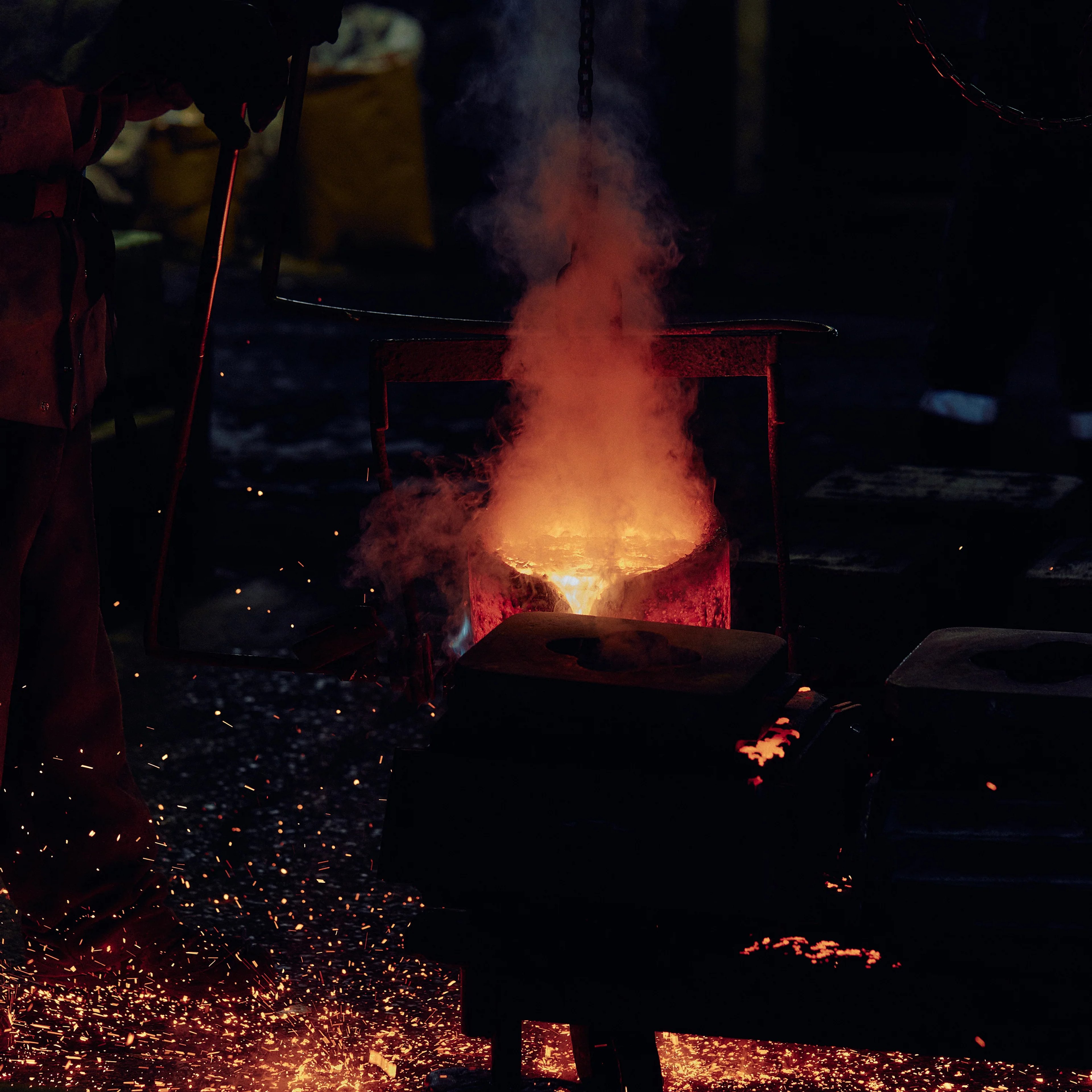
Foundry, by Dina Grinberg, 2022
Isolation
Immigration brought all these cultures to a faraway continent, a long way from everywhere else. The nearest major cities overseas, like Jakarta and Singapore, are at least six hours away by plane from Sydney. Anyone who comes to Australia is, in a way, physically cut off from the rest of the world.
That distance shapes design in a very practical way. Australia has little large-scale manufacturing left, and the home market is small, so a designer often can't just hand a drawing to a big factory. Instead, many make things themselves or work with other local designers and manufacturers, often in small batches. Ideas and innovation often arise from working with constraints.

Surface Sconce in Blackened Bronze by Henry Wilson, imagery by THINK OF THINGS
For example Henry Wilson, he wanted to experiment with a local foundry that normally casts metal parts for mining equipment, trains and cars, but he was after something sculptural for the home. Out of that experiment came his signature Surface Sconce.

Honey Lamp by Coco Flip
Being small and far away also makes for a tight-knit design community. It's small enough that most people know each other, which sounds like a limitation but is really a strength: you can pick up the phone to the person who casts the metal or creates ceramics, and designers tend to help one another rather than compete.
You can see the same thing in Coco Flip's Honey lamp, where several local makers come together to build one product: R.L. Foote Design Studio, a few suburbs away in Melbourne, makes the ceramic base, and a local glassblower hand-blows the shade.

Nature
Isolation cuts Australia off from the world, but it brings people close to the land. Wherever you live in Australia, nature feels close. Growing up in the south-west of Sydney, I was a 25-minute drive from Cronulla Beach and a 10-minute walk from a local creek. Even in the middle of Sydney, you can walk down to the harbour, or get to a beach like Bondi in minutes.
And it's not only about distance. It's also about how places are built. Most local councils in Australia require new buildings to set aside space for plants and trees, and to provide parks and green spaces nearby.
This closeness shapes how designers think. It gives them a backdrop of respect for nature. Australian designers were talking about sustainability, long life and quality well before "sustainability" became a fashionable word. (I think it's good that more people talk about it now, even when it's only marketing. Better to keep it in mind than to forget it.)

KeepCup, the original Barista standard reusable cup brand
One of the brands that I respected most whilst living in Australia was KeepCup. They created the first barista-standard reusable coffee cup, which you can bring to cafes/juice shops etc and get your drink. This product brings together a few traits of Australian design culture. The first is that people like to challenge the status quo: at the time, the idea of bringing your own cup to a cafe to get coffee was strange, yet Abigail Forsyth challenged this and created the cup that then became a popular movement with cafe-goers in Australia. The second is a respect for nature — minimising waste and reusing where we can. Now, we can see many brands of reusable cups and cafes accepting these all around the world.

Seven Seeds Coffee Roasters in Melbourne, imagery by Gareth Sobey
Where Australians gather
There's one more part of everyday life that shapes how Australians design, and it might surprise you: the cafe. During the talk, Yasunaga-san mentioned how different Australian cafes are. They open early, around 6am, and close early, around 3pm. Australians build their day around the morning coffee. The baristas feel like friends: they remember your name, and you chat with them about your weekend and your life. We have morning meetings there, meet colleagues before work, drop back in after lunch, and see friends there on weekends. The cafe is a central part of Australian life.

The Italian Forum 2000 (Leichart, Sydney) imagery by Quentin Jones
People start their day early, with a first coffee in the morning and in the office by 7:30 or 8, and then head home around the time the cafe closes, keeping the rest of the afternoon for themselves. Australians work hard, but they also know how to switch off. They really value the balance between work and life.
This coffee culture came from immigrants, mainly the Italian and Greek families who arrived after the Second World War. They brought espresso with them and, just as importantly, the social side of coffee. When I was young, I remember visiting Leichhardt, the Italian neighbourhood in Sydney. There was a place called The Italian Forum, where local Italian families and their friends would gather to eat and talk over coffee any time of the day. That same warmth has grown into the cafe culture we have today in Australia with all types of people visiting the cafe and using it as a space of social interaction and business.

Coco Flip in MIA MIA Tokyo, imagery by dolive media
You may have felt a little of it here in Japan: over the last few years, Australian and Australian-style cafes, and the flat white, have made it onto cafe menus in Tokyo. If you’ve visited Mia Mia cafe in Higashi-Nagasaki, Tokyo, you can get a sense for the cheery vibe, with the owner Vaughan facilitating a friendly vibe amongst customers and whilst enjoying Australian style coffee and wine. Other cafes such as Single O from Sydney now have branches in Tokyo, bringing the same quality of coffee and even coffee on tap.
It's not just cafes, either. Australians love to gather at home too: a barbecue in the backyard, friends over for dinner, everyone spilling out of the kitchen into the backyard or balcony. Since moving to Japan, I've noticed the difference. Here, people often gather out, at a restaurant or an izakaya, while in Australia we tend to open up our homes. So the home, like the cafe, is really a social space.
So what does all of this gathering have to do with design? So much of our life happens in shared, social spaces. We gather to eat, to talk, to work, to relax, and we care how those places feel. That shapes what designers make. A lot of Australian design tends to be made for spaces where people come together. Design tends to be distinct, sometimes bold but not overwhelmingly distracting and somewhat playful, which we discuss in the next section.
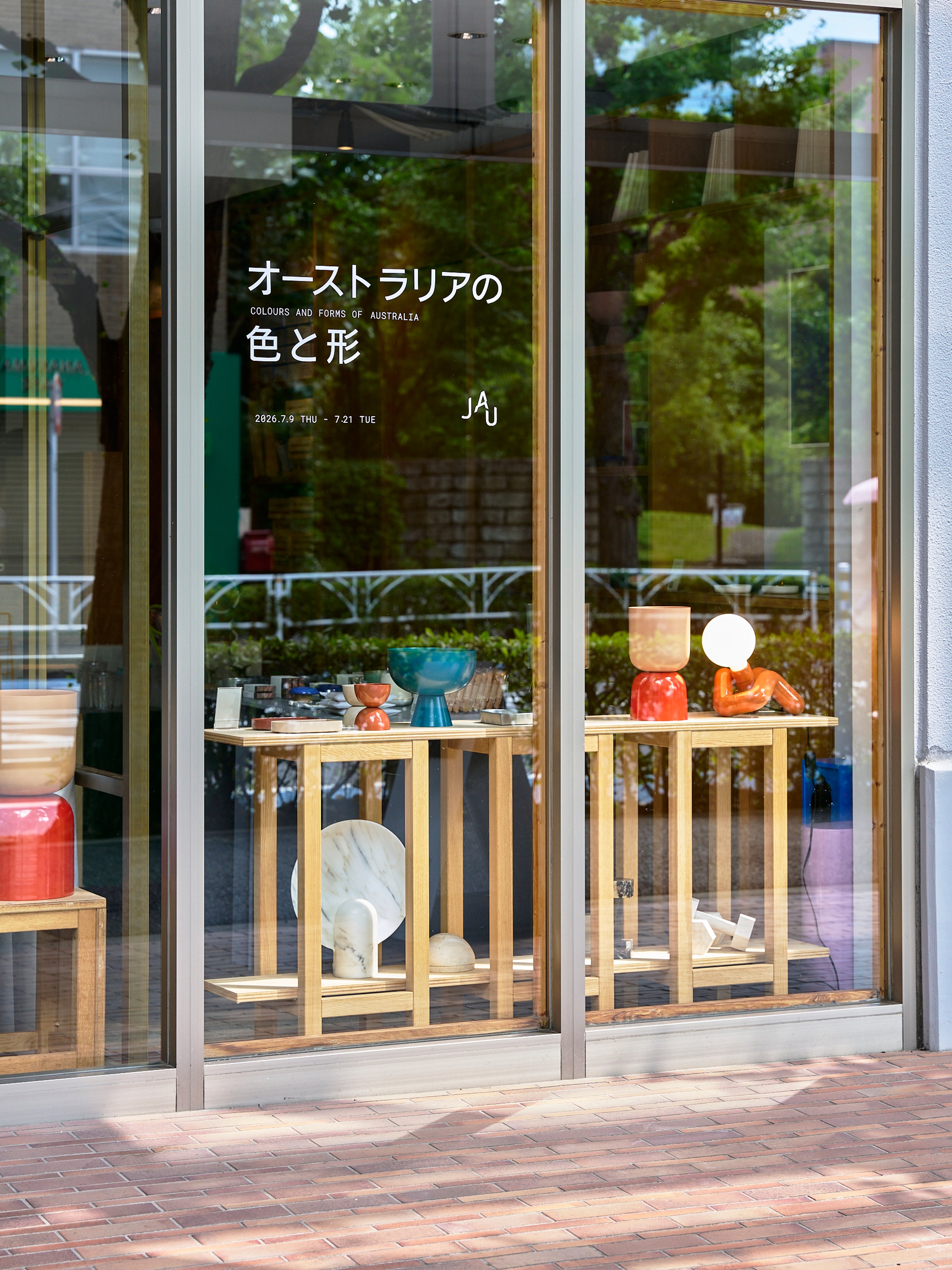
Colours and Forms of Australia Exhibition (2026), imagery by THINK OF THINGS
So what are the colours and forms?
So what about the literal colours and forms — after everything we've covered: who we are, where we are, how we live alongside nature, and where we gather? The first thing I'd say is that Australian design is more playful, and more varied, than people expect.
For example, colour. I think the strong, bright light in Australia lets us use bold colour in a way softer climates can't. At one end you have studios like Lightly, whose planters come in playful shapes and bright colours: vivid blues and yellows, warm reds and greens. Fearon's aluminium furniture is just as bold. At the other end is a studio like Coco Flip, who I admire a lot, working in soft curves and quiet, muted tones, but there is a subtle sense of play.

Ceto Wall lamp by Ross Gardam, imagery by Sonny Mai
The same range shows up in materials. There's raw, honest materials, especially bare metals like cast brass, bronze and aluminium, often left unfinished so you can see the surface and the marks of how they were made. Studio Henry Wilson works at the raw, rough end of this. Ross Gardam works at the other, more refined and luxurious end, though his pieces are still made largely by hand, pushing materials like frosted glass and brass into new shapes.
So if I had to name the one thing they all share, it wouldn't be colour, or any single material. It'd be a sense of play, honesty about materials, and things made by hand to last.

Sonny Mai at 'Colours and Forms of Australia' student talk session, imagery by Naoki Shimakawa
Bridges
To conclude, Australian design is open-minded and always looking for opportunity, shaped and bridged by many cultures mixing together and by the creativity that comes from isolation. It stays close to nature — to its light and materials — with a real care for making things that last. And it's playful in form and honest about materials, made with thought for the social spaces where people come together.
I hope this has given you some context about Australian design, mainly how culture and the environment influence it. We'll cover some of these topics more deeply in future pieces.
Our goal as a team is to create more bridges, by sharing more Australian design and culture to Japan, and also, to connect local Japanese designers and manufacturers with our Australian designers to make things together.
I'm proud that we've already built some small bridges between the two countries, and I think we need more like them: I believe countries and cultures coming closer, learning from each other, and building things together is a good thing for humanity.
Feel free to get in touch with us if you have any questions, or ideas of your own for connecting Australia and Japan through design or culture.
Thank you again for reading.
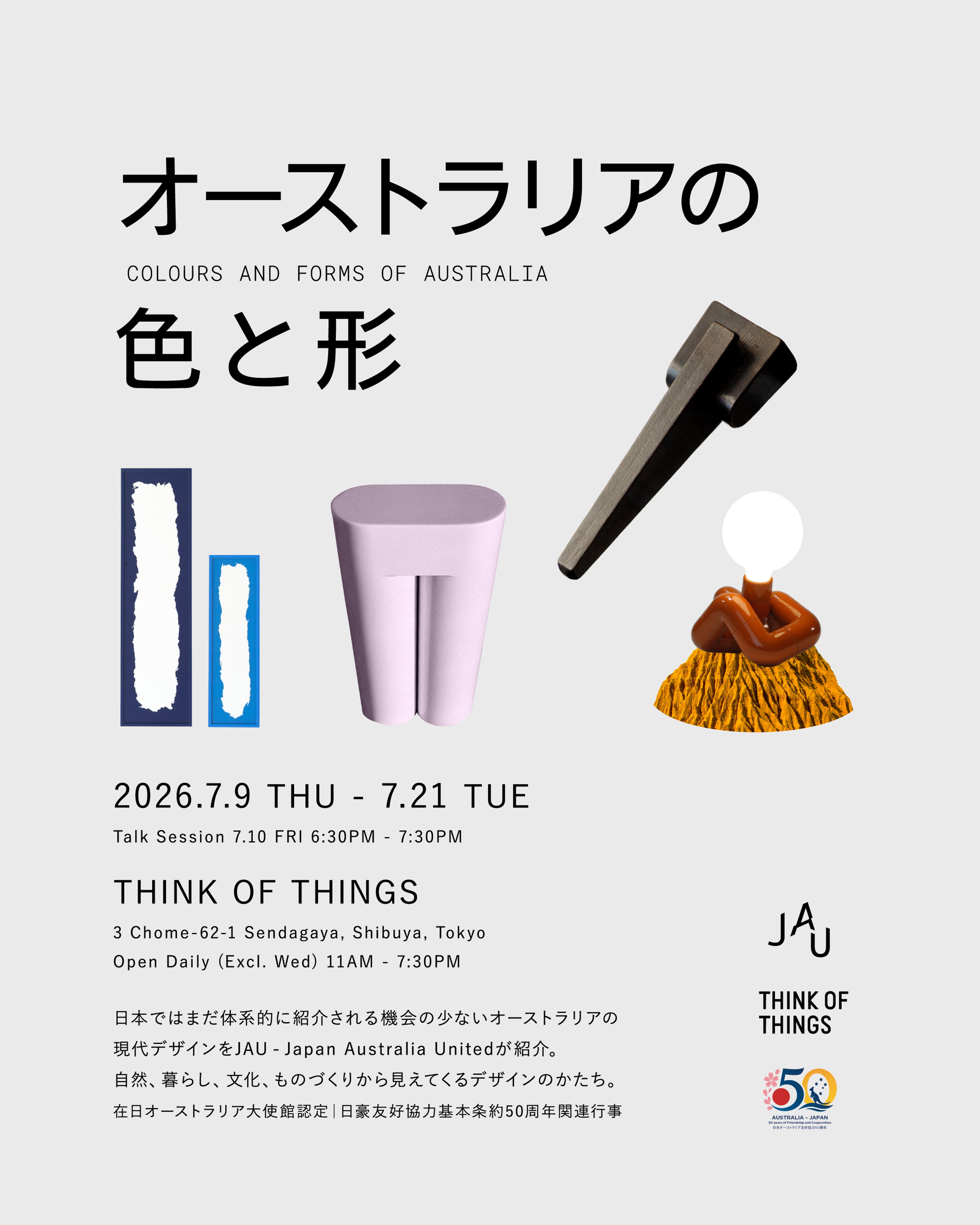
Colours and Forms of Australia
We are pleased to present 'Colours and Forms of Australia' at THINK OF THINGS in Sendagaya, Tokyo; a special exhibition showcasing contemporary Australian design, a field that has rarely been introduced in Japan until now.
Focusing on the unique use of colour and material expression cultivated through Australia’s nature, lifestyle, and culture, the exhibition will display and offer for sale works by a diverse range of designers and studios.
Exhibition and Related Program Details
Venue: THINK OF THINGS – 1F (Exhibition), 2F (Talk Session)
Dates: Exhibition: July 9 (Thu) – July 21 (Tue) / Talk Session: July 10 (Fri)
Admission: Exhibition: Free / Talk Session: General Admission ¥1,100 (plus one-drink requirement) / Student Admission ¥550
Learn more